Read the guidance and listen to the full episode:
Navigating the complexities of sterile manufacturing
For pharmaceutical quality assurance, manufacturing, and engineering leaders, translating evolving regulatory standards into daily operational compliance is a perpetual balancing act. Since the revised EU/PIC/S Annex 1 came into force, facilities globally have wrestled with operationalizing its expanded expectations for sterile product manufacturing. To eliminate ambiguity and align global regulatory oversight, the Pharmaceutical Inspection Co-operation Scheme (PIC/S) — in close collaboration with the European Medicines Agency (EMA) and the World Health Organization (WHO) — formally adopted Recommendation PI 058-1 on October 28, 2026.
Titled Interpretation of the Most Important Changes in the Annex 1 on the Manufacture of Sterile Products (2022), PI 058-1 does not introduce new Good Manufacturing Practice (GMP) rules. Instead, it provides technical interpretation on how regulators will inspect compliance against the 2022 Annex 1 text. While much of the guidance codifies modern industry practices, several interpretations explicitly challenge entrenched operational habits, legacy validation rationales, and common audit assumptions. Below is a breakdown of the six most surprising, counter-intuitive, and high-impact takeaways every sterile drug manufacturer must digest — and immediately act upon.
Takeaway 1: VHP is surface bio-decontamination, not true sterilization
The misconception & technical reality
For years, many site engineering and validation teams operated under the assumption that running an automated Vaporized Hydrogen Peroxide (VHP) cycle inside an isolator or lyophilizer constituted a validated sterilization process. PI 058-1 firmly dispels this notion.
Annex 1 intentionally excludes VHP from its official list of validated sterilization methods (paragraphs 8.50 to 8.78). Regulators cite VHP's recognized process fragility, limited penetration capability, and extreme sensitivity to surface cleanliness, surface defects, micro-cracks, and occluded areas. Consequently, VHP is classified strictly as a surface bio-decontamination agent, not a true sterilant.
Critical operational nuances
Where VHP is acceptable
Under Annex 1 (Q&A 4.21 & 4.22), validated VHP cycles remain fully acceptable for surface bio-decontamination where the regulation explicitly permits bio-decontamination — such as RABS outer glove surfaces, isolator interior enclosures, and material transfer airlocks.
Where VHP is a regulatory deficiency
For equipment and components requiring true sterilization — specifically product-contact parts, stopper bowls, and lyophilizer chambers — relying on VHP in lieu of a validated thermal or chemical sterilization method (such as moist heat/steam) is a direct compliance failure.
The guidance leaves no room for ambiguity regarding freeze-dryers:
"Where lyophilisers are just bio-decontaminated by VHP and not sterilised, this should be considered as a deficiency."
If a facility intends to use VHP for sterilization of equipment or indirect product-contact parts, it faces an extraordinarily high burden of proof: it must scientifically demonstrate an equivalent level of sterility assurance that fully overcomes VHP's inherent penetration and surface limitations.
CCS integration
Your facility's Contamination Control Strategy (CCS) must explicitly differentiate between bio-decontamination steps and validated sterilization steps. Any process relying on VHP for items that contact or impact sterile pathways must feature a rigorous, risk-assessed equivalency justification within the CCS.
QA action step: Audit all equipment decontamination protocols immediately. Identify any lyophilizers, stopper bowls, or indirect contact equipment currently reliant on VHP cycles without thermal sterilization validation, and draft engineering CAPAs to transition to steam/moist heat or defend equivalent sterility assurance.
Takeaway 2: strict calendar disinfectant rotation is actually a myth
The misconception & technical reality
A deeply ingrained doctrine in cleanroom sanitation management has been the rigid, calendar-based rotation of disinfectants (e.g., swapping Agent A for Agent B every two weeks). This practice largely stems from legacy auditor preferences rather than sound microbiological science. PI 058-1 clarifies that Annex 1 does not mandate a fixed calendar schedule for alternating cleaning agents.
Focus on efficacy over arbitrary schedules
The actual baseline requirement (Q&A 4.33) is twofold:
- Facilities must utilize more than one type of disinfecting agent.
- Facilities must periodically incorporate a sporicidal agent.
While alternating agents on a set calendar rotation remains an acceptable execution strategy, sticking to an arbitrary schedule offers zero regulatory shield if microbial resistance or persistent flora emerge. Regulators are shifting the focus from mindless routine compliance to data-driven efficacy.
What inspectors demand is formal, localized validation proving that the selected sanitation regime effectively kills target surface contaminants — specifically local environmental monitoring (EM) isolates of bacteria and fungi — under actual use conditions and contact times.
CCS integration
Your disinfectant selection rationale, sporicidal application frequency, and residue-removal validations must be embedded directly within the CCS. Rather than auditing calendar adherence, Quality Assurance must continuously evaluate EM isolate trends to verify that the active sanitation regime remains effective.
QA action step: Re-evaluate your cleanroom cleaning SOPs. Move away from rigid calendar rotation justifications and verify that your disinfectant validation packages specifically demonstrate kill efficacy against recent local facility isolates under actual contact conditions.
Takeaway 3: your Contamination Control Strategy does not need to be one single, massive document
The misconception & technical reality
When the revised Annex 1 mandated a holistic Contamination Control Strategy, a wave of panic swept through QA departments. Many facilities spent hundreds of executive hours drafting 500-page standalone master documents that duplicated pre-existing site SOPs. PI 058-1 (Q&A 2.3 Q#2) clarifies that there is no prescribed format requiring a monolithic CCS.
Integration over duplication
Manufacturers are fully permitted to reference existing, controlled quality system elements — such as environmental monitoring programs, gowning qualification protocols, cleaning validation packages, and utility maintenance systems.
"The objective is not to duplicate all these programs into another document. The objective is to demonstrate how these systems work together to prevent contamination."
The guidance also clarifies an important scope expansion: CCS principles are not confined to sterile drug manufacturing (Q&A 4.1 Q#1). Facilities producing non-sterile products in Grade C or D cleanrooms (e.g., low-bioburden oral liquids or topical formulations) should also implement CCS framework principles to manage contamination risks systematically.
Review frequency and lifecycle management
The guidance establishes clear expectations for maintaining the CCS as a living document:
Minimum review frequency
At least annually (e.g., integrated into Management Review or Periodic Product Quality Reviews).
Event-driven reviews
Immediate re-evaluation required during major facility changes, significant EM excursions, CAPA investigations, or emerging quality trends.
CCS integration
The CCS document itself should function as a high-level navigational matrix and risk assessment that explains how sub-systems interact, identifies potential contamination mechanisms, and references lower-level SOPs and validations.
QA action step: Streamline your CCS structure. Replace redundant, duplicated text with cross-references to established site validation programs, and institute a formal procedure ensuring the CCS is reviewed at least annually and after any major quality excursion.
Takeaway 4: skipping cleanroom grade cascades during transfer is permissible (under strict conditions)
The misconception & technical reality
Traditional facility engineering dogma dictates that raw materials, equipment, and components must sequentially transition through every single cleanroom grade (e.g., Unclassified → Grade D → Grade C → Grade B). PI 058-1 provides pragmatic flexibility by clarifying that strict adherence to this sequential cascade is not universally mandatory.
Disambiguating transfer expectations: Grade C vs. Grade A/B
To apply this flexibility correctly without incurring inspection observations, QA teams must distinguish between transfers into lower-grade cleanrooms versus transfers into critical processing zones (Q&A 4.12 Q#1 & Q#2):
Skipping cascades into Grade C (Q&A 4.12 Q#2)
Moving materials directly from an unclassified area into a Grade C cleanroom (skipping Grade D) is explicitly permissible, provided the transfer mechanism is fully validated and risk-assessed.
Transfers into Grade A/B (Q&A 4.12 Q#1)
Transfers into high-grade aseptic areas require strict, validated transfer mechanisms. These must utilize approved material lists and verified controls such as pass-through airlocks, Rapid Transfer Systems (RTS) for isolators, bacterial retention filters, validated surface disinfection or sterilization, and integrity-sealed packaging.
This nuanced clarification proves that Annex 1 prioritizes scientifically justified Quality Risk Management (QRM) over rigid room-sequence dogma.
CCS integration
Any material flow that bypasses a traditional cleanroom grade cascade must be explicitly mapped, risk-assessed, and validated within the facility's CCS, detailing exact surface decontamination protocols and protective packaging controls.
Takeaway 5: air velocity (0.36–0.54 m/s) is a guidance value, not an absolute mandate
The misconception & technical reality
Annex 1 paragraph 4.30 references a homogeneous airflow velocity range of 0.36 to 0.54 m/s at the working position for unidirectional airflow (UDAF) in Grade A areas. Facility engineers and validation specialists have historically treated this range as a non-negotiable pass/fail specification during annual cleanroom requalification. PI 058-1 (Q&A 4.19 & 4.30) clarifies that this metric is a guidance value, not an absolute operational mandate.
Scientific justification for deviations
Operating within the standard 0.36–0.54 m/s range can introduce severe quality risks in specific processes. For example, during the dry powder filling of parenterals or handling of fine active powders, air speeds above 0.35 m/s can cause product dispersion, billowing, or air turbulence that compromises container fill accuracy and disperses particulates.
Regulators accept operating outside the 0.36–0.54 m/s range under two strict conditions:
CCS documentation
The alternative airflow velocity must be scientifically justified and documented in the CCS.
Smoke study correlation
Airflow visualization studies (smoke studies) under dynamic operating conditions must physically correlate with the lower (or higher) velocity measurements to prove continuous "first-air protection" over exposed critical product contact points.
CCS integration
Your CCS must move beyond recording scalar velocity numbers. It must detail how unidirectional airflow dynamics protect the sterile core, providing empirical smoke study video evidence whenever operating parameters deviate from standard guidance ranges.
QA action step: Review Grade A airflow qualification data for powder filling or sensitive processing lines. If velocities operate outside 0.36–0.54 m/s, ensure a comprehensive risk assessment exists in your CCS alongside dynamic airflow visualization videos demonstrating intact first-air protection.
Takeaway 6: ISO standards will not shield you from strict Aseptic Process Simulation (APS) expectations
The misconception & technical reality
Facilities operating advanced, highly automated isolator filling lines have frequently attempted to cite ISO 13408-1 (section 8.2.5.1) to justify reducing their routine Aseptic Process Simulation (APS / media fill) frequency to once per year. PI 058-1 (Q&A 9.38 Q#1) firmly shuts down this compliance shortcut.
"ISO 13408-1 does not override Annex 1 requirements. Annex 1 states 'normally APS should be repeated at least twice per year' for each aseptic process, each filling line and each shift."
Regardless of how automated or isolated a line is, Annex 1 expectations take absolute precedence over external industry consensus standards.
Core APS compliance parameters & mandatory failure protocols
Routine APS frequency
Media fills must be conducted at least twice per year per shift, per filling line, and per aseptic process (Q&A 9.38 Q#1).
Intervention challenge realism
The number of interventions included in an APS must reflect the absolute frequency of standard and non-standard interventions expected during routine commercial production (Q&A 9.34 Q#1). Reducing intervention counts to pass an APS is explicitly cited as a poorly controlled process failure.
Rigorous APS failure protocols (Q&A 9.46 Q#1 & Q#2)
If an APS fails due to a microbial contaminated unit:
- Simply identifying a root cause and implementing CAPAs is insufficient to resume commercial filling.
- Commercial release of any at-risk batches produced prior to the failure is strictly prohibited until a full investigation is completed AND a minimum of three consecutive successful repeat APS runs are executed.
CCS integration
Your facility's APS policy, matrix rationale, intervention listings, and emergency re-qualification procedures must be fully harmonized with your CCS risk assessments. Citing ISO standards to bypass Annex 1 frequencies will lead directly to major inspection findings.
QA action step: Review your site media fill master plans. Eliminate any validation rationales relying on ISO 13408-1 to reduce APS frequencies. Ensure your APS failure procedures enforce mandatory quarantine of at-risk product pending completion of three successful repeat runs.
Summary comparison: legacy myths vs. PI 058-1 reality
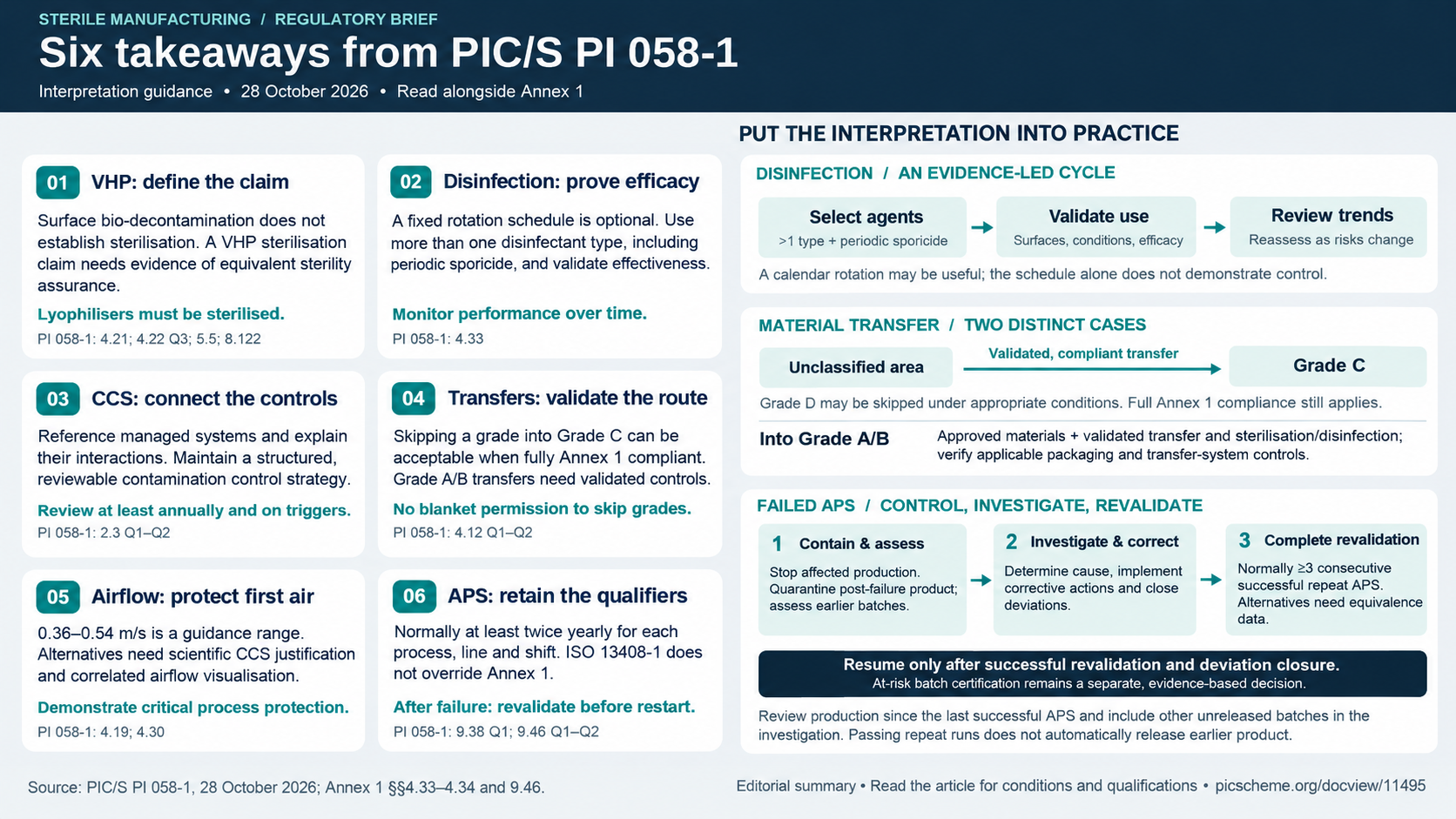
Conclusion: from paperwork to real control
The publication of PIC/S PI 058-1 delivers an unambiguous message to the global pharmaceutical sector: genuine sterility assurance stems from integrated, operational risk control — not administrative paperwork or compliance checklists.
"The question every sterile manufacturing facility should be asking is not whether it has implemented Annex 1. It is whether it can demonstrate that its contamination control strategy actually works."
As Quality Assurance, Microbiology, and Facility Engineering leadership convene to align site protocols with this interpretation guidance, the focus must shift beyond procedural documentation. Are your facility's contamination control strategies, validation frameworks, and equipment designs driving measurable, real-world risk reduction — or are they merely satisfying a paper compliance exercise?
Source: PIC/S Recommendation PI 058-1 (picscheme.org), adopted 28 October 2026, and EudraLex Volume 4, Annex 1 (European Commission). Discussed on The Regulatory Mix.
References
- PIC/S Recommendation PI 058-1: Guidance on the Interpretation of Annex 1 (Manufacture of Sterile Medicinal Products). Pharmaceutical Inspection Co-operation Scheme, adopted 28 October 2026. picscheme.org/docview/11495
- EudraLex Volume 4: EU Guidelines to Good Manufacturing Practice, Annex 1 — Manufacture of Sterile Medicinal Products. European Commission, revised 25 August 2022. Read the Annex 1 PDF · EudraLex Volume 4 index
- The Regulatory Mix — “The End of Checklist Sterility: PIC/S PI 058-1 & the New Annex 1 Realities”. Spotify · Apple Podcasts · YouTube
Written by
Joseph Lambert, PharmD, BCSCP
Founder and Principal Consultant, Tailwind Pharma
Former FDA field investigator, former compliance officer in CDER's Office of Manufacturing Quality, and former Vice President of Corporate Quality Assurance for a $4 billion global pharmaceutical company. Advises manufacturers, CDMOs, and compounding facilities on FDA inspections, 483 and Warning Letter responses, and quality-system remediation.
Related
Aligning your site with the Annex 1 interpretations?
A 15-minute introductory discussion to understand your situation and agree the next step. Technical review is scoped separately.
This article is general information from a consulting perspective summarizing a public regulatory guidance document. It is not legal advice and does not replace the facility's designated Quality Unit or regulatory counsel.