
1. Introduction: the policy twist opening the door to peptides
In a watershed policy directive, Health and Human Services (HHS) Secretary Robert F. Kennedy Jr. announced an interim enforcement discretion framework permitting 503A compounding pharmacies to compound six high-demand bulk peptide substances. This sudden shift opens a legal domestic avenue for popular wellness peptides — BPC-157, TB-500, Epitalon, Semax, KPV, and MOTS-c — which previously languished in regulatory limbo under Category 2 status from September 2023 through April 2026.
The directive exposes a sharp institutional fracture within the federal health apparatus. Driven by HHS leadership, the policy aims to expand patient access to emerging therapeutic modalities while simultaneously crippling the proliferation of dangerous, foreign-manufactured "research-use-only" (RUO) imports shipped directly to consumers from overseas suppliers. However, this executive move occurred over intense opposition from career scientists within the Food and Drug Administration's (FDA) Center for Drug Evaluation and Research (CDER). CDER officials cautioned that relaxing restrictions outside the formal 503A bulk drug substances rulemaking process risks undermining U.S. drug safety standards and creating a back door for unproven therapeutics.
While this interim enforcement discretion opens significant commercial horizons for 503A compounders, it carries stringent operational boundaries. To maintain immunity from federal enforcement, compounding facilities must transition from traditional pharmacy-level quality checks to biopharmaceutical-grade quality assurance, analytical rigor, and supply chain oversight.
2. Takeaway 1: a regulatory drama — HHS bypasses FDA to displace foreign RUO markets
The interim policy reflects an extraordinary administrative rift between HHS leadership, FDA's CDER, and the Pharmacy Compounding Advisory Committee (PCAC). During administrative reviews, CDER recommended against listing these peptide forms, citing unresolved characterization gaps, unverified safety profiles, and a lack of standard clinical trial approvals. Conversely, the PCAC voted in favor of their inclusion. Exercising authority over agency decisions, HHS bypassed CDER's objections to establish a regulated domestic supply chain.
HHS justified overriding CDER's stance by pointing to material changes in the technical record. Specifically, newly submitted, lot-specific Certificates of Analysis (COAs) from FDA-registered manufacturing facilities supplied the exact identity, purity, endotoxin, microbial, and residual solvent characterizations that CDER previously identified as lacking.
Furthermore, the policy targets the illicit, direct-to-consumer gray market. Unregulated foreign manufacturers — primarily operating out of China — have flooded the U.S. market with unvalidated "research-use-only" peptide vials, posing acute safety risks to desperate or wellness-focused patients.
"The Secretary of HHS has determined that this limited enforcement-discretion policy will discourage the continued, widespread use of certain research-use-only peptides supplied by foreign manufacturers that pose a safety risk to US patients. By allowing limited compounding of the substances addressed in this guidance under appropriate safeguards, the policy provides patients with a more controlled alternative."
Crucially, enforcement discretion does not apply to generic peptide active pharmaceutical ingredients (APIs). The policy explicitly dictates the exact chemical salt forms authorized under Appendix A:
BPC-157 Acetate
Subcutaneous, intramuscular, oral, topical
TB-500 Acetate
Subcutaneous, intramuscular injectable
Epitalon Acetate
Subcutaneous, intramuscular injectable
KPV Acetate
Topical, oral
MOTS-c Acetate
Subcutaneous, intramuscular injectable
Semax (Free Base)
Intranasal only
For 503A compounding facilities, this administrative rift creates a high-stakes operational landscape. While compounders can now legally fulfill patient-specific prescriptions for these specific chemical forms, enforcement discretion is contingent on absolute compliance. A single quality failure, supply chain gap, or unauthorized salt form selection removes the pharmacy from safe-harbor protection, exposing the facility to federal misbranding and unapproved drug charges.
3. Takeaway 2: supply chain lock-down — vendor validation and original manufacturer tracking
To neutralize the security risks of unverified overseas sourcing, HHS has instituted strict supply chain and vendor qualification rules. Compounders can no longer accept broker-provided documentation or rely on "blind sourcing" through third-party distributors.
To maintain compliance under the interim policy, 503A compounders must enforce three foundational supply chain mandates:
FDA registration
The bulk drug substance must be synthesized by a manufacturing facility formally registered under Section 510 of the Federal Food, Drug, and Cosmetic (FD&C) Act.
Original manufacturer auditing
The COA supplied to the 503A pharmacy must explicitly disclose the corporate name, physical facility address, and FDA Establishment Identifier (FEI) number of the original bulk drug substance manufacturer — not an intermediate repacker, relabeler, or distributor. The primary manufacturing facility must actively maintain compliance with Current Good Manufacturing Practice (CGMP) standards per ICH Q7 guidelines.
Repacker / reseller validation
When sourcing APIs through intermediate suppliers, the compounder must maintain documented proof that the reseller conducted rigorous vendor qualification of the original manufacturer and independently validated the accuracy of the manufacturer's COA.
Strategic QA insight: senior QA managers must immediately update their facility's Vendor Qualification Programs (VQPs). Pharmacy quality teams must actively cross-reference vendor-supplied FEI numbers against FDA's Establishment Registration databases and import alert lists. Relying on intermediate distributor COAs without documented audit trails of the original synthesis site invalidates safe-harbor protections under this policy.
4. Takeaway 3: testing standards elevation — say goodbye to basic COAs, enter "orthogonal analysis"
The policy's Testing Standard for Peptides Used in Compounding eliminates reliance on simple, single-method identity testing. Bulk peptide substances must undergo comprehensive multi-method characterization before being cleared for compounding.
Central to these expectations is the mandatory implementation of orthogonal analytical methods. In practical biopharmaceutical characterization, orthogonality requires pairing analytical procedures based on fundamentally different physical or chemical principles. For example, verifying primary sequence identity cannot rely solely on High-Performance Liquid Chromatography (HPLC) retention times; it must pair HPLC coelution with Tandem Mass Spectrometry (LC-MS/MS) or Quantitative Amino Acid Analysis (AAA). Similarly, evaluating Higher Order Structure (HOS) and aggregation requires pairing Size-Exclusion Chromatography with Multi-Angle Light Scattering (SEC-MALS) alongside Dynamic Light Scattering (DLS) or Circular Dichroism (CD).
Furthermore, the policy establishes a strict structural threshold: complex peptides containing 8 or more amino acids — which includes BPC-157 (15 amino acids) and MOTS-c (16 amino acids) — must undergo specialized secondary/tertiary structure verification, aggregation profiling, and biological activity/bioassays pursuant to USP <1503>.
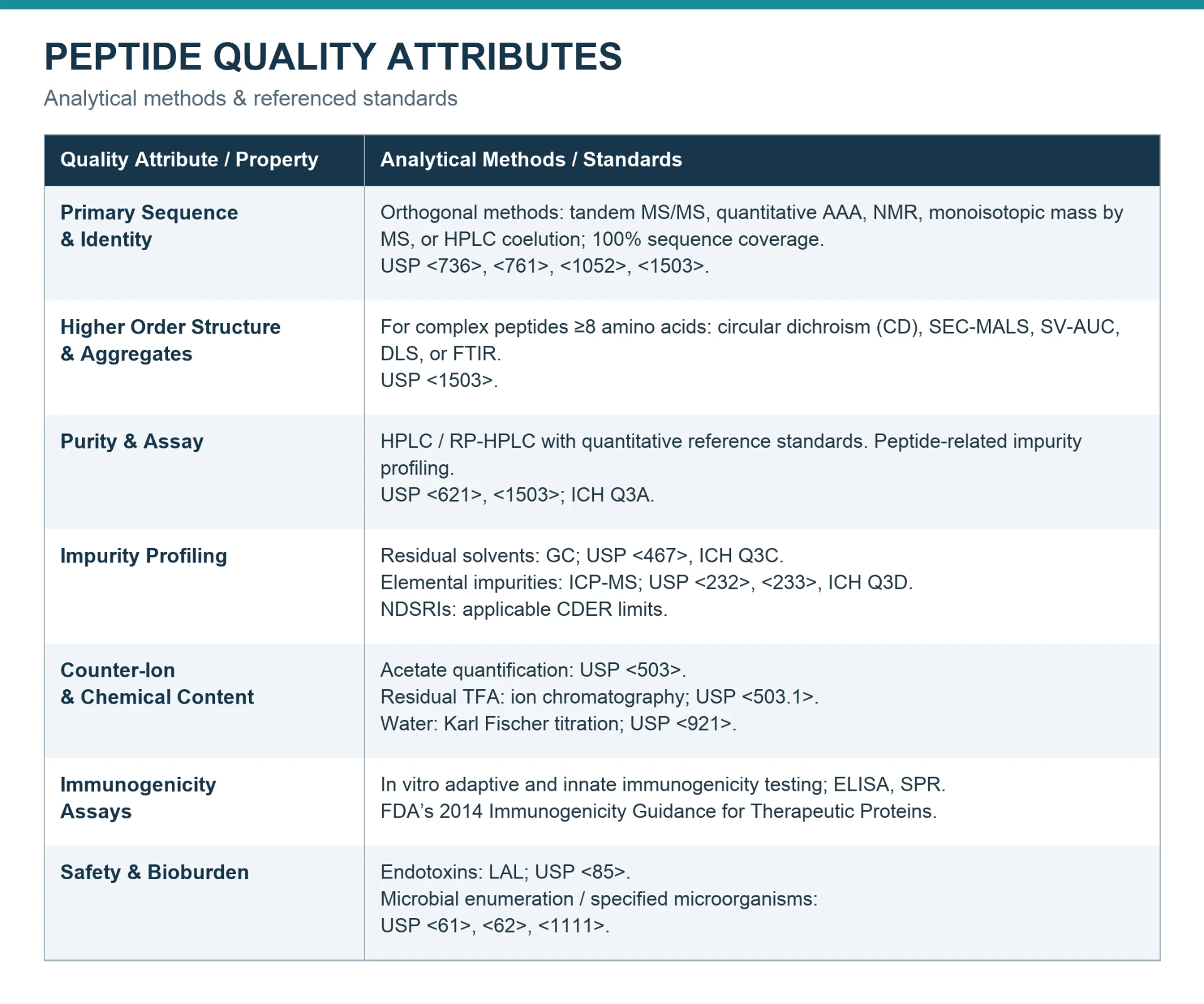
This rigorous testing protocol elevates quality assurance expectations for 503A compounding facilities, requiring a shift from passive paperwork review to active biopharmaceutical-grade analytical validation.
5. Takeaway 4: strict formulation and device boundaries — single APIs and syringe limitations
The interim enforcement discretion policy establishes strict boundaries regarding final product formulations, delivery methods, and administration routes:
Single-API limitation
Compounded formulations must contain only one Active Pharmaceutical Ingredient listed in Appendix A. Multi-peptide "cocktails" or "stacks" — for example, combining BPC-157 Acetate and TB-500 Acetate in a single vial — are strictly prohibited under enforcement discretion. Restricting preparations to single entities ensures that adverse events can be clearly attributed to a specific molecule during national safety surveillance.
Route of administration restrictions
Peptides are limited strictly to their validated, authorized routes, as listed in Appendix A above. Semax (Free Base) is restricted exclusively to intranasal administration; KPV Acetate to topical and oral forms; the remaining substances to the injectable, oral, or topical routes their authorizations specify.
The oral bioavailability barrier
Achieving systemic therapeutic absorption with oral peptides is notoriously difficult due to enzymatic degradation in the gastrointestinal tract. Consequently, the policy mandates that any compounder preparing oral formulations of BPC-157 Acetate or KPV Acetate must maintain documented clinical evidence demonstrating that their exact formulation vehicle achieves adequate oral bioavailability in humans.
Delivery devices
Co-packaged or pre-filled drug delivery devices are strictly limited to FDA 510(k)-cleared syringes. Micro-pumps, auto-injectors, or unvetted delivery hardware are excluded from enforcement discretion.
Strategic QA insight: commercial leadership must immediately audit pharmacy order sets and catalog offerings. Popular multi-peptide combinations must be unbundled into separate, single-entity prescriptions. Furthermore, compounding oral peptide capsules without human bioavailability data for the specific excipient matrix strips away enforcement discretion protections.
6. Takeaway 5: mandatory vigilance and documentation — the new paper trail
To maintain safe-harbor protections, 503A facilities must implement comprehensive recordkeeping, mandatory pharmacovigilance, and explicit product labeling.
Mandatory MedWatch reporting
Compounding facilities must report all serious adverse events and product quality defects — such as sterility failures, physical precipitation, or potency out-of-specification results — to the FDA's MedWatch program and the state boards of pharmacy where the product was compounded and distributed. Crucially, serious adverse event reporting is mandatory regardless of whether the event is definitively confirmed to be drug-related. Reports must explicitly detail the active ingredient, strength, dosage form, route of administration, and the original API manufacturer's name and FEI number.
Product labeling requirements
Outer secondary packaging must prominently display the following mandatory statement:
"This is a compounded drug product. Not for resale."
Patient-facing labeling must also provide written instructions detailing how patients can directly report adverse events and quality defects to the pharmacy and regulatory authorities.
Comprehensive COA elements
Every batch of API received and utilized must be accompanied by an exhaustive COA containing:
- Complete substance identity: chemical structure, sequence, molecular formula, and molecular weight.
- Original manufacturer's corporate name, physical address, and FEI number, plus FEI numbers for any reprocessor or repacker.
- Batch number, synthesis date, release date, and retest or expiration date.
- Defined storage conditions and an explicit statement of intended dosage form purpose.
- Designated grade statement: "Intended for human drug compounding."
- An explicit compliance declaration: "This product was manufactured and tested in compliance with CGMP."
- Formal signature and date from authorized Quality Unit personnel.
7. Conclusion: the path forward for 503A compounders
HHS's interim enforcement policy represents a dramatic pivot in federal peptide oversight, offering 503A compounding pharmacies a legal avenue to serve patients while the formal 503A bulk drug substances rulemaking proceeds. However, this flexibility comes at the cost of strict regulatory accountability. By demanding single-API formulations, original manufacturer verification, orthogonal testing protocols, and mandatory pharmacovigilance, federal regulators have raised the baseline for compliant operations.
As the industry adjusts to this heightened oversight, compounding executive teams must critically evaluate their operating model: is your 503A facility fully prepared to invest in the analytical characterization, vendor qualification programs, and quality assurance infrastructure necessary to operate in this new era of peptide regulation?
Sources: HHS Federal Register notice (91 FR 68526), HHS 503A peptide enforcement discretion policy docket (Docket No. HHS-OASH-2026-0496). Discussed on The Regulatory Mix.
Written by
Joseph Lambert, PharmD, BCSCP
Founder and Principal Consultant, Tailwind Pharma
Former FDA field investigator, former compliance officer in CDER's Office of Manufacturing Quality, and former Vice President of Corporate Quality Assurance for a $4 billion global pharmaceutical company. Advises manufacturers, CDMOs, and compounding facilities on FDA inspections, 483 and Warning Letter responses, and quality-system remediation.
Related
Reviewing your peptide compounding program?
A 15-minute introductory discussion to understand your situation and agree the next step. Technical review is scoped separately.
This article is general information from a consulting perspective summarizing a public federal policy. It is not legal advice and does not replace the facility's designated Quality Unit or regulatory counsel.